
HGV Drivers’ Hours Made Easy
Understanding HGV drivers’ hours, tachograph rules, and working time regulations can often feel confusing for both drivers and transport operators. Calculating legal driving hours, required breaks, and rest periods is not always straightforward. This guide simplifies the key rules to help UK HGV drivers better understand what is required.
This guide is for HGV drivers, owner-drivers and transport managers. It covers the UK’s assimilated drivers’ hours rules, formerly called EU drivers’ hours rules, and how they work with road transport working time rules. The vehicle and journey determine which rules apply. Some operations fall under GB domestic or AETR rules.
See the DVSA guide to goods vehicle drivers’ hours and tachographs for the full rules and exemptions.
Driving Limits and Breaks
Driving Limits
- Maximum 9 hours of driving per day, which may be increased to 10 hours twice a week
- Maximum 56 driving hours per week
- Maximum 90 driving hours over a two-week period
Driving Breaks
Drivers must take a 45-minute break after 4.5 hours of driving, unless beginning a rest period.
The 4.5-hour driving time can be continuous or built up through shorter driving periods totaling 4.5 hours.
You can take the driving break in two parts.
- 15 minutes minimum, followed by
- 30 minutes minimum
Take the first break during the driving period. Complete the second break before resuming driving after 4 hours and 30 minutes of accumulated driving.
Breaks shorter than 15 minutes do not count as official breaks, although they are not considered driving time. For split breaks to qualify, the second break must be at least 30 minutes long.
Daily and Weekly Rest Requirements
Daily Rest
For a single driver under the standard rules, a regular daily rest is at least 11 continuous hours. Complete the daily rest within 24 hours of the end of the previous daily or weekly rest.
A regular daily rest can also be split into two parts.
- A first uninterrupted rest period of at least 3 hours
- A second uninterrupted rest period of at least 9 hours
Together, this creates a minimum of 12 hours total rest.
A reduced daily rest lasts at least 9 continuous hours and less than 11 hours. Drivers can take it up to three times between weekly rest periods.
Weekly Rest
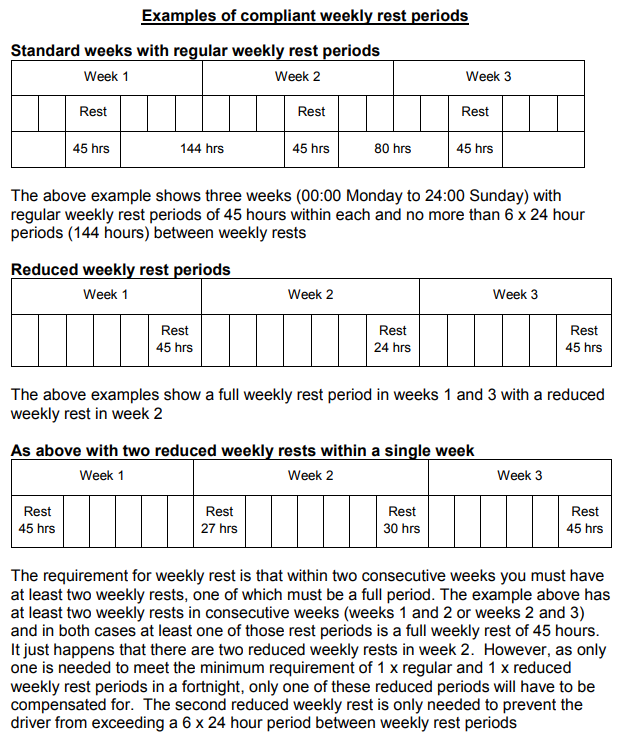
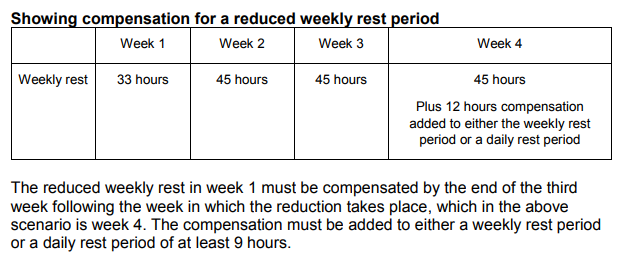
In any two consecutive fixed weeks, the standard rule requires two weekly rests, including at least one regular rest of 45 hours. A reduced weekly rest must be at least 24 hours and requires compensation.
Start the next weekly rest by the end of the sixth 24-hour period after the last weekly rest ends.
Example of Daily Rest Compliance
If the previous rest ends at 7:00 a.m., the driver has until 7:00 a.m. the next day to complete one of these rest periods.
- 11 uninterrupted hours of regular daily rest
- 12 hours of split daily rest (minimum 3 hours + 9 hours)
- A reduced daily rest of at least 9 uninterrupted hours, if eligible
Road Transport Working Time Rules
Working Time Limits
Apply these limits to working time, including driving.
- Average no more than 48 hours per week over the applicable reference period
- Not exceed 60 hours in a single week, provided the average limit is maintained
- Stay within 10 working hours in any 24-hour period when night work is performed, unless a collective or workforce agreement permits longer
Working Time Breaks
Apply both sets of break rules when a shift combines driving and other duties. A break can count towards both sets of rules if it meets both requirements. See the DVSA working time guidance.
Observe these working time break requirements.
- No more than 6 hours of work without a break
- Minimum break length of 15 minutes
Your total working time determines how much break time you need.
- For 6 to 9 hours of work, take at least 30 minutes of breaks in total. This can be split into two 15-minute breaks.
- For more than 9 hours of work, take at least 45 minutes of breaks in total.
Rest Under Working Time Rules
Under the road transport working time rules covered here, the assimilated drivers’ hours rules govern daily and weekly rest.
Who Do These Rules Apply To?
These rules generally cover the following vehicles.
- Goods vehicles over 3.5 tonnes
- Vehicle and trailer combinations exceeding 3.5 tonnes
Weight is based on maximum permissible mass, including a trailer or semi-trailer. Since 1 July 2026, the assimilated rules can also cover certain international goods operations in vehicles or combinations exceeding 2.5 tonnes. See the DVSA rules on scope and exemptions.
Tachograph Symbols
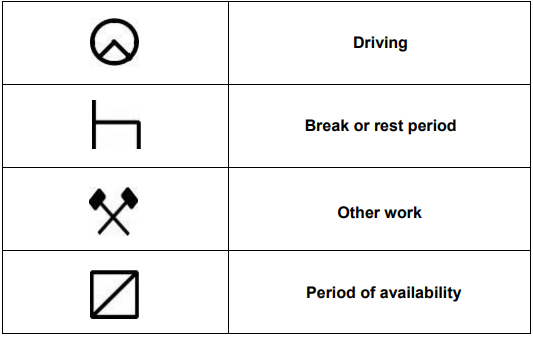
Understanding tachograph symbols is also important for staying compliant with HGV drivers’ hours rules and accurately recording driving, work, breaks, and rest periods.
Driving Hours and Shift Length
How Many Hours Can an HGV Driver Drive Per Day?
Under drivers’ hours regulations, an HGV driver is generally allowed to drive up to 9 hours per day between daily or weekly rest periods. However, this limit can be extended to 10 hours in a day, but only twice within the same week.
How Long Can an HGV Driver’s Shift Be?
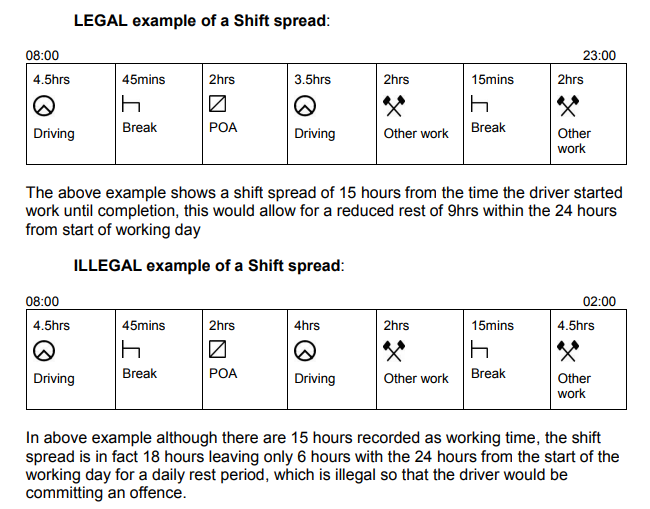
The length of a single-driver shift depends on the rest that fits within the applicable 24-hour period. Separate limits apply to driving, working time and night work.
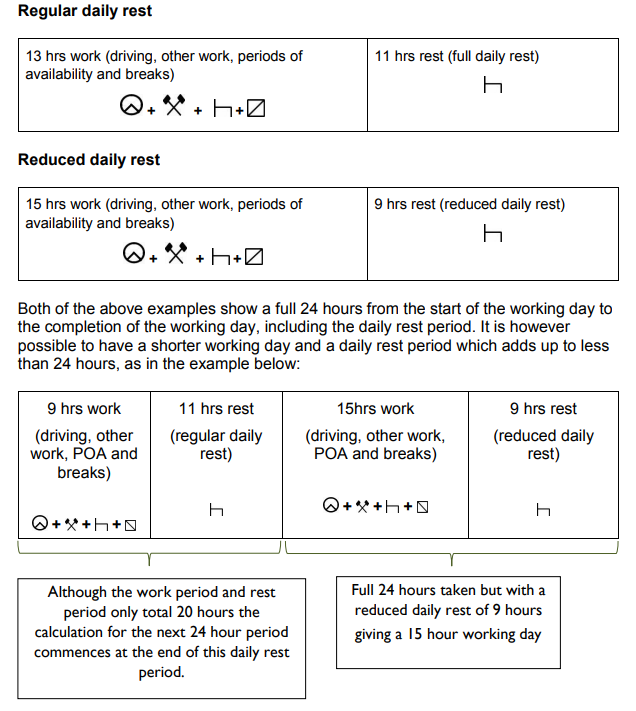
A 15-hour shift span leaves 9 hours in the 24-hour period. Those 9 hours can count as reduced daily rest, or as the final part of a regular split rest if the driver already took an uninterrupted 3-hour rest.
Taking a single 11-hour regular daily rest leaves up to 13 hours before that rest must begin.
A shift can include all of the following.
- Driving time
- Other work duties
- Breaks
- Periods of availability
Although only driving and other duties count as working time, breaks and availability periods still affect the total working day. These must be considered to ensure drivers receive the legally required rest before starting their next shift.
What Is a Period of Availability?
A period of availability (POA) is generally time spent waiting while available to resume duties. A qualifying POA is excluded from working time.
The expected length of the wait generally needs to be known before departure or immediately before it starts. A wait of unknown duration generally counts as working time.
HGV Drivers Working at Night
For goods vehicle drivers, the night time period is generally defined as any work carried out between midnight and 4:00 a.m.
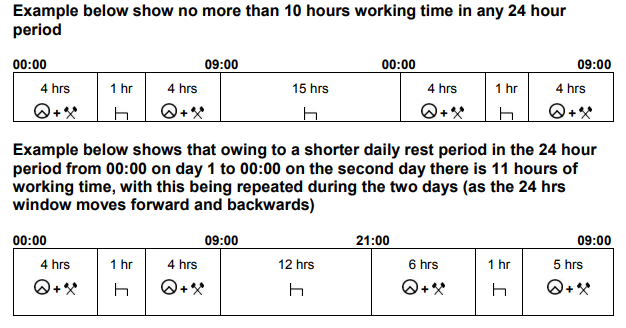
According to working time regulations, if any part of a driver’s duties — including driving — takes place during this night period, the driver is normally restricted to a maximum of 10 working hours within a 24-hour period.
A collective or workforce agreement can permit longer night working hours.
Drivers must still meet the applicable driving, working time and rest requirements if an agreement permits longer night work.
How Many Hours Can an HGV Driver Drive in a Week?
An HGV driver can drive a maximum of 56 hours in a single week. For example, this could include driving 9 hours on four days and 10 hours on two days.
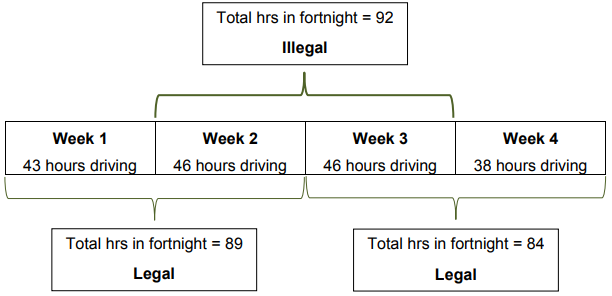
However, drivers must also follow the fortnightly driving limit, meaning total driving time across any two consecutive weeks cannot exceed 90 hours. When calculating legal driving hours, it is important to review both the current and previous week to ensure compliance with the two-week rule.
For the weekly driving limits, the fixed week runs from the start of Monday to the end of Sunday.
How Many Hours Can an HGV Driver Work in a Week?
An HGV driver must not work more than 60 hours in any single week, including both driving and other job-related duties. In addition, average working time must remain within 48 hours per week over a set monitoring period.
What Is a Reference Period?
A reference period is the time used to calculate average weekly working hours. It is normally 17 weeks. A collective or workforce agreement can extend it to up to 26 weeks.
The average weekly working time is measured across this continuous period to ensure drivers stay within legal limits.
Under the statutory default calendar, a period starts at the beginning of the first Monday on or after 1 April, 1 August or 1 December and ends when the next period starts. Some default periods span 18 weeks. See the reference period provisions for the applicable arrangements.
In short, drivers must maintain an average of no more than 48 working hours per week during the reference period. However, they may work up to 60 hours in a single week, provided the overall average stays within the legal limit.
How Does a 15-Hour Shift Affect Daily Rest?
Drivers can take reduced daily rest on up to three occasions between weekly rest periods.
A 15-hour shift span may include breaks and periods of availability. The three-reduction limit applies when the 9-hour rest is a reduced daily rest. A qualifying 3-hour and 9-hour split counts as regular daily rest.
Break Examples and Requirements
What Breaks Must an HGV Driver Take in a Day?
Track driving time and total working time separately. The two break rules use different clocks, and both can apply on the same shift.
Breaks While Driving
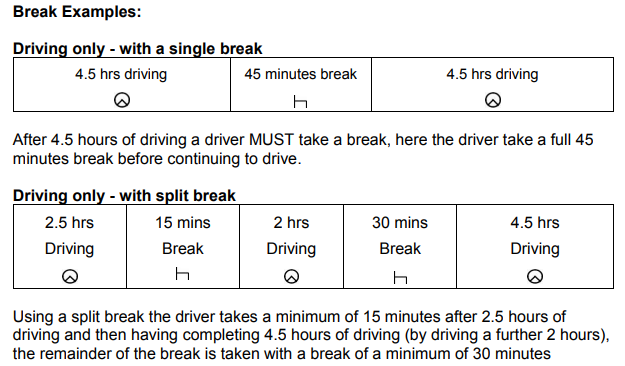
When driving, an HGV driver must take a 45-minute break after 4.5 hours of driving.
A split driving break follows this order.
- 15 minutes first
- Followed by 30 minutes
The order matters — a driver cannot take the 30-minute break first and the 15-minute break later.
Once a full 45-minute break has been completed, another break becomes necessary after an additional 4.5 hours of driving.
Breaks During Other Work
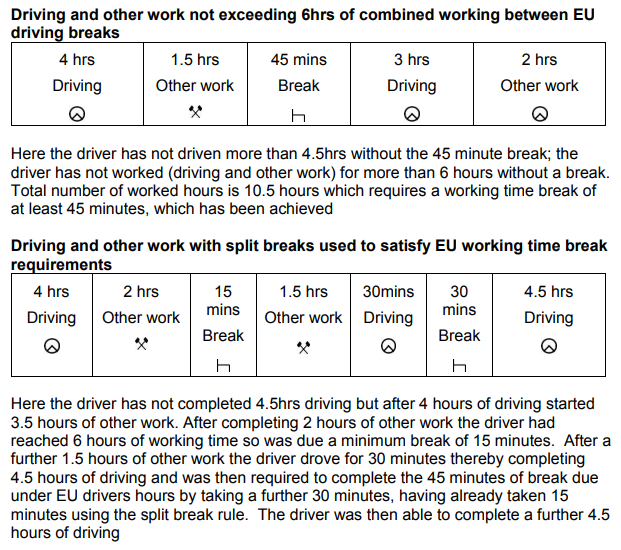
Include driving and other duties when applying the working time break requirements.
The required break time depends on how much work you do.
- At least 30 minutes in total for 6 to 9 hours of work
- At least 45 minutes in total for more than 9 hours of work
These breaks may be divided into 15-minute periods. Drivers must also avoid working more than 6 continuous hours without taking a break.
Why Are Driving and Working Break Rules Different?
The driving break clock counts accumulated driving. The working time break clock includes driving and other work, so either rule can require a break first.
How to Know When a Break Is Required
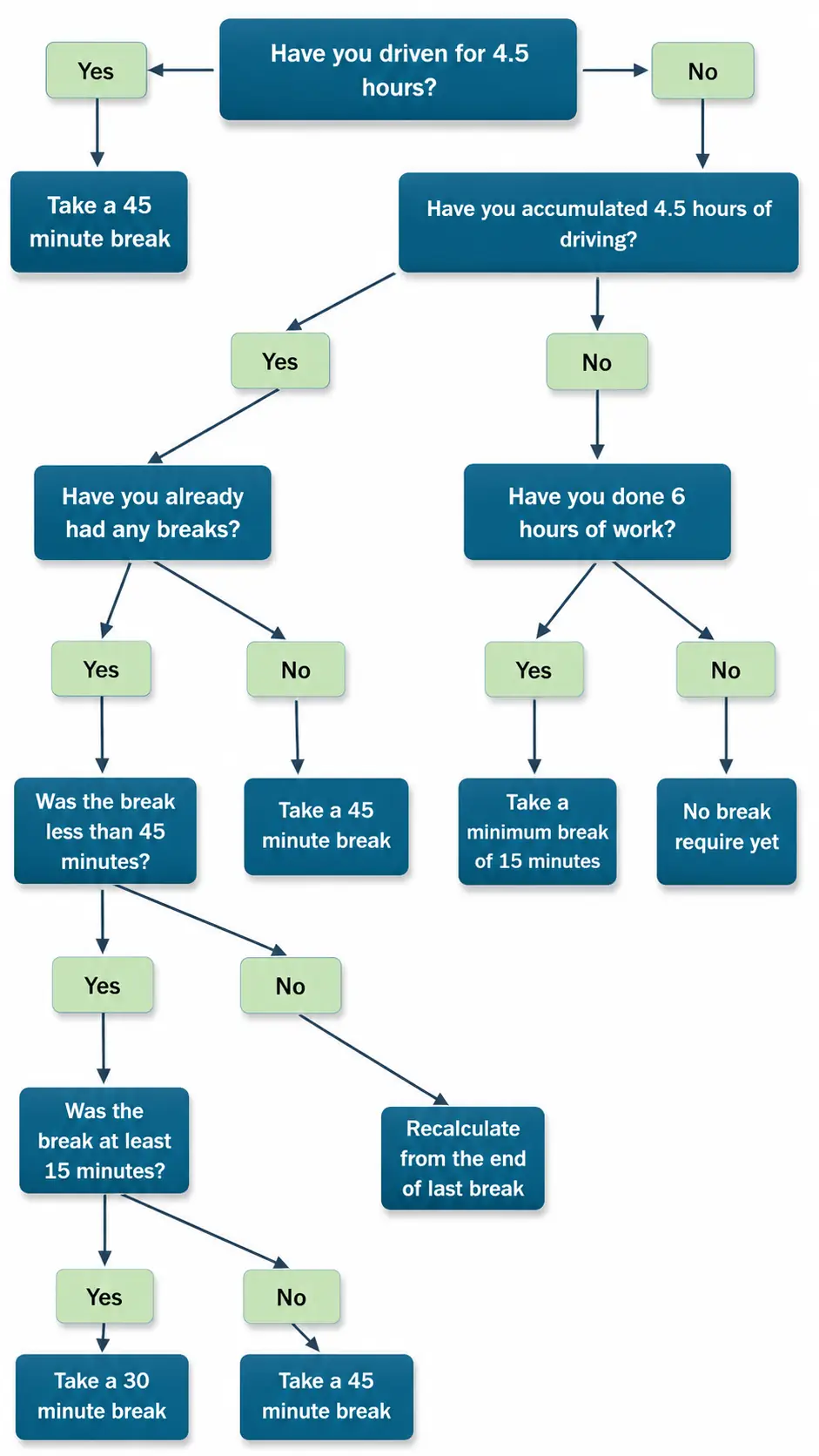
Under the assimilated rules, a qualifying break is due after no more than 4 hours and 30 minutes of accumulated driving, unless a rest period begins.
Confusion often occurs when drivers combine driving with other tasks. For example, if non-driving work is completed before driving begins, that time still counts toward total working time and must be included when calculating breaks.
Plan your break around the first limit you reach.
- 4.5 hours of driving, or
- 6 hours of total work (including driving)
Whichever happens first.
What Counts as a Break?
A break is defined as a period during the working day when a driver is not driving or performing any work duties.
Break time should be used solely for rest, recovery, and relaxation, and it must be uninterrupted.
Can Drivers Take Breaks in an HGV?
Yes. Drivers are currently allowed to take breaks inside their vehicle, provided they are not carrying out any work and are genuinely using the time to rest and recover.
When to Take a Break
Daily Rest Examples
What Daily Rest Must an HGV Driver Take?
A single driver following the standard rules must complete daily rest within 24 hours of the end of the previous daily or weekly rest. A continuous regular daily rest lasts at least 11 hours.
However, drivers may reduce this rest to 9 continuous hours, up to three times between weekly rest periods. This is referred to as a reduced daily rest period.
Drivers can also take a regular daily rest in two uninterrupted periods.
- The first rest period must be at least 3 uninterrupted hours
- The second rest period must be at least 9 uninterrupted hours
This creates a combined minimum rest total of 12 hours. There is no limit on how often split daily rest periods can be used.
Taking Daily Rest in an HGV
Drivers may take daily rest or reduced weekly rest in the vehicle under the following conditions.
- The vehicle has appropriate sleeping facilities
- The vehicle remains stationary during the rest period
Take regular weekly rest and any weekly rest of more than 45 hours that includes compensation outside the vehicle.
Daily Rest Example
If the previous rest ends at 5:00 a.m., the driver has until 5:00 a.m. the next day to complete one of these rest periods.
- A regular daily rest of at least 11 continuous hours
- A split daily rest of at least 12 hours in total
- 3 hours minimum for the first rest period
- 9 hours minimum for the second rest period
- A reduced daily rest of at least 9 continuous hours but less than 11 hours, where permitted.
Weekly Rest and Compensation
What Weekly Rest Must an HGV Driver Take?
A driver must start weekly rest by the end of the sixth 24-hour period following the end of the previous weekly rest.
A regular weekly rest is at least 45 continuous hours. A reduced weekly rest can be as short as 24 hours. Take the hours deducted from 45 as one block by the end of the third week following the reduction. Add that block to a rest of at least 9 hours.
The standard rule requires two weekly rest periods in any two consecutive fixed weeks, with at least one regular weekly rest. The DVSA drivers’ hours guide explains the exceptions for qualifying international journeys.
Count the six 24-hour periods from the end of your actual weekly rest. Use the Monday-to-Sunday fixed weeks separately when checking the weekly and two-week limits.
What Is a Rest Period?
A rest period is an uninterrupted block of time during which an HGV driver is completely free from work responsibilities. During this time, the driver may spend their time however they choose, provided they are not carrying out any work-related activities.
Keep accurate records of rest so that drivers and operators can demonstrate compliance with the rules.
Recording and Calculating Working Time
What Counts as Working Time for an HGV Driver?
Working time includes activities connected with transport operations. Common examples follow.
- Driving
- Loading and unloading goods
- Completing Driver CPC training or other work-related training
- Vehicle cleaning and maintenance
- Supervising loading or unloading to ensure goods are handled safely
- Conducting daily vehicle checks and defect reporting
- Time at a workstation, including the vehicle, when the driver must stay ready for duties and cannot use the time freely
- Administrative tasks linked to transport-related legal or regulatory requirements
- Waiting periods where the expected duration is unknown in advance, either before departure or immediately before the waiting period begins
Time Excluded From Working Time
Exclude these activities from working time calculations.
- Travel between home and a normal workplace
- Breaks and rest periods
- Qualifying periods of availability
Recording Driving and Working Hours
The tachograph records driving time automatically. Drivers should select the correct mode for other work, availability, breaks and rest, and make manual entries when required.
Employers must keep accurate working time records for two years after the period they cover. Tachograph records can form part of that record. Use a reliable record system for working time the tachograph does not capture.
Tools for Managing HGV Drivers’ Hours
HGV Drivers’ Hours Apps
Several apps are available to help HGV drivers monitor driving hours, breaks, and working time.
Common app features include the following.
- Track driving time
- Warn drivers about possible rule breaches
- Help avoid infringements of HGV drivers’ hours regulations
- Show remaining available driving hours
These apps are commonly available on Apple and Android devices.
HGV Drivers’ Hours Calculators
Online calculators can help drivers estimate the following times and totals.
- Start and finish times
- Rest periods
- Driving hours
- Working hours records
These tools can support accurate timesheet management and help drivers remain compliant with legal requirements.